Carbon Sinks and Carbon Dioxide Removal
Protecting, restoring, and creating natural carbon sinks
Oceans, forests, soils, and wetlands are all carbon sinks: they pull carbon dioxide from the atmosphere and hold onto it. Together, these sinks absorb 41% of each year’s GHG emissions, and the carbon that they absorb each year is only a small fraction of the total carbon they hold. Soils and vegetation hold 2 ¾ times more carbon than the atmosphere contains, for instance; and the oceans hold a whopping 45 times more carbon than the atmosphere. In the graphic below, you can see the total amount of CO2 in the atmosphere, the amount that industrial emissions and land-use change each contributed to that, and the total size of the earth’s other sinks.
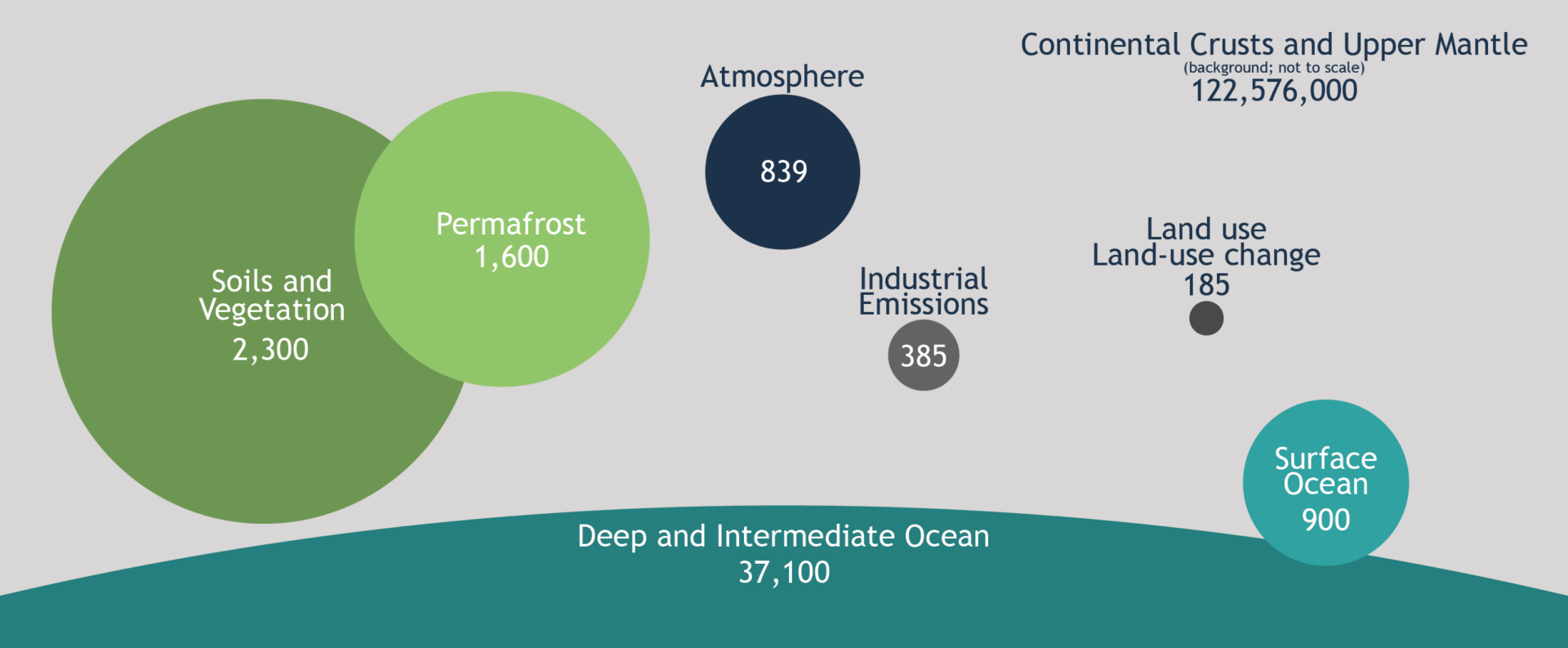
(Source: https://www.fs.usda.gov/ccrc/topics/global-carbon. Units are gigatons of CO2.)
Natural carbon sinks are our ally in the fight against climate change, but we are actively degrading their ability to help us; and in some cases, we are not only shrinking these sinks, we are turning them into potent new sources of GHG emissions. When we drain wetlands or peat bogs, we not only reduce their ability to absorb new carbon from the atmosphere; we cause them to release the carbon they’ve absorbed over hundreds of years. When we slash and burn the Amazon, we release the carbon stored in the trees we destroy, and we may do even more than this: because removing trees alters the water cycle that sustains the larger forest, and we risk initiating an ecological process that will transform vast swaths of the entire forest into dry savannahs, able to hold only a small fraction of the carbon that the rain forest currently holds.
All of this means that one of the most impactful climate solutions is simply to stop destroying and degrading natural carbon sinks. Doing this helps us on both sides of the climate ledger: it preserves the sinks’ ability to pull carbon from the atmosphere (their so-called “negative emissions”); and it stops carbon already stored in the sinks from being released into the atmosphere.
And we can do more than simply stopping new damage. We can re-wet peatlands and wetlands that have been drained, replant coastal mangroves that have been cleared, reforest land areas that have been cut recently – and plant new trees where there have been none for centuries, and use a host of other strategies to build or rebuild natural carbon sinks.
Preserving and rebuilding natural sinks has enormous “co-benefits,” because these sinks are not just holders of carbon; they are essential habitats for thousands and thousands of species. In preserving and rebuilding these sinks, we fight the planet’s climate crisis and its equally serious biodiversity crisis at the same time. And because some of the most important and vulnerable natural sinks are the homelands of indigenous peoples, we can often protect them by securing indigenous peoples’ land tenure rights. This is one of many cases where protecting the climate, protecting nature, and advancing justice all point us in the same in direction.
⇒ Watch this great mini-lecture on natural carbon sinks from Dr. Jonathan Foley, executive director of Project Drawdown:
⇒ And look at Project Drawdown’s detailed analyses of the many ways we can protect, restore, and build up carbon sinks on land and in coastlines and oceans.
All of these strategies will help natural systems pull carbon out of the air, and so they are all fall under the umbrella category of nature-based Carbon Dioxide Removal (CDR).
Engineered CDR
In the last few years, a huge number of researchers and start-ups have begun to explore and develop a large number of methods of CDR beyond nature-based CDR. As we’ll see, some of these seek to make use of natural processes, or to accelerate processes that occur in nature. Others are purely engineered solutions. For instance, Direct Air Capture (DAC) uses giant machines to suck CO2 out of ambient air, and then store it away – for instance, by piping it deep underground and storing it in geological formations, where it can remain locked up (“sequestered”) for tens of thousands of years.

(Rendering of Climeworks “Mammoth” DAC facility, currently under construction. Credit: Climeworks.)
(CDR is different from Carbon Capture and Sequestration (CCS). CCS involves capturing CO2 from the exhaust stream of an industrial facility, where the flu gasses might be anywhere from 5% to 95% CO2, depending on the facility. DAC, on the other hand, involves capturing carbon dioxide from ambient air, where it is very dilute. Whereas CCS can prevent some of the emissions that an industrial facility would otherwise produce, only CDR actually reduces the total amount of CO2 in the atmosphere. We discuss CCS separately, in the page on CLEANING UP ELECTRICITY.)

(Credit: Carbon 180)
While everyone recognizes that nature-based CDR is a good thing, many climate advocates are wary of attempts to develop and deploy engineered forms of CDR. They point out that it’s extremely expensive right now and that, to date, the amount of CO2 we have managed to sequester with these technologies is miniscule. We simply don’t know whether it will be possible to scale it enough to play any meaningful role. So, it would be foolish to bet on it. They argue that CDR is a distraction from carbon mitigation – that is, from cutting our emissions. This is something we do know how to do, and so we should be spending our money, time, and effort on that.
Behind these worries about CDR is a deeper – and well-founded – worry. The fossil fuel industry and its political allies are only too happy to tout CDR as a climate solution. In fact, Occidental Petroleum recently purchased Carbon Engineering, a DAC company, for $1.1 billion. Oil companies suggest that CDR will allow the world reach net-zero emissions even as we continue to burn large quantities of fossil fuels, because we will be able to remove and sequester carbon equal to our continuing emissions. The industry uses the prospect of both CDR and CCS as a form of social license – so that it can claim to be responsible, even as it continues to invest in new fossil infrastructure.
Why do we need engineered CDR?
Critics of engineered CDR are right that it would be foolish and dangerous to allow CDR to serve as an excuse not to slash emissions as fast and radically as we possibly can. Even in the best scenario, CDR would remove only a small fraction of our current emissions – and we do not know whether we will be able to scale it enough to do even that. But we have to try. The third part of the UN IPCC 6th assessment report gives us four, strong reasons why we need CDR. You can read a great summary by Zeke Hausather and Jane Flagel in this excellent article. Here are the reasons:
- Residual carbon dioxide emissions. While we have the technology we need to eliminate most CO2 emissions, there are some sources of emissions – like long-haul aviation – that we do not currently know how to decarbonize fully. We should expect that these sectors will still be emitting a few billion tons (gigatons) of CO2 each year in 2050. In order to reach net-zero by 2050, we will need to rely on CDR to remove those residual gigatons of CO2.
- Residual emissions of other GHGs. Non-CO2 GHGs such as methane and nitrous oxide come from sources such as fertilizer runoff, cattle, sewage and manure, as well as from the decomposition of organic matter in wetlands. With changes to agricultural practices, we should be able to reduce some of these GHG emissions, but we will not be able to eliminate all of them. Again, in order to reach net zero, we will need to rely on CDR to compensate for these residual, non-CO2 emissions.
- Overshoot. In 2023, it looks almost certain that, even if we succeed in scaling CDR, the world will overshoot the goal of limiting warming to 1.5 C – and it’s likely, unless we take much more ambitious action, that we will overshoot the goal of 2 degrees C as well. Whenever we reach net-zero, the world should stop warming. But in order to bring temperatures back down to 2 degrees or 1.5, we will need to lower atmospheric concentrations of carbon. That is, our emissions will need to be net negative.
- Hedging uncertainty in the climate system. Scientists understand a great deal about the climate system, but there is still significant uncertainty. This means that even if the world adopts an emissions trajectory that that is calculated to give us a 50% chance of limiting warming to 1.5 degrees (the ambitious goal of the Paris Agreement), that trajectory might turn out to produce dangerously more warming than 1.5 degrees. CDR offers us a way to respond if the climate warms more than we expect.
In the scenario pictured below, the world reaches net zero when residual emissions (in red) are balanced by “negative emissions” from both nature-based CDR (dark green) and engineered CDR (light green). When negative emissions exceed residual emissions, the concentration of CO2 in the atmosphere begins to decline.

The IPCC’s climate modeling shows that while nature-based CDR (protecting and growing forests, wetlands, and other natural carbon sinks) can help, it cannot provide the quantity of carbon removal that the planet will need by 2050. While they reach this conclusion through sophisticated modeling, we can understand the basic facts behind it in simpler terms. The carbon in the atmosphere includes both carbon that comes from plants, animals, and microrganisms living in the “biosphere” (as when trees burn or agricultural waste decomposes), and carbon that we have extracted, in the form of fossil fuels, from the deep geological formations of the “lithosphere.” It is plausible to suppose that if we restore the natural processes that we have damaged, we might restore rough equilibrium in the biospheric carbon cycle, so that growing forests absorb and balance the carbon from burning trees, for instance. But to ask biospheric processes to absorb and retain all the carbon we have dug up from the earth, in addition, is to ask too much. We need to return some of that carbon to the enormous carbon sink that is the lithosphere.
If you want a much more detailed argument for the necessity of engineered CDR, read the Energy Transitions Commission’s excellent report, “Mind the Gap.”
Is engineered CDR feasible?
The fact that we need engineered CDR to meet our climate goals does not mean that we can have it. Right now, a few start-ups have managed to remove and sequester a few thousand tons of CO2. In likely IPCC scenarios, we will need to remove ten gigatons (ten billion tons) of CO2 per year by 2050. And so far, the CDR that has been accomplished has been astronomically expensive – with costs ranging from $600 to $2000 per ton. Even if it becomes technologically possible to remove carbon at the scale we need, it is doubtful that the world would do so at those prices.
The fact that CDR has never been deployed at a meaningful scale (and that most of the approaches to CDR that have been proposed have never been deployed outside of laboratories) is one reason it is so expensive. Solar panels, lithium ion batteries, and many other technologies were also prohibitively expensive when they were first invented. As we explained in the section on ENERGY, each of these technologies has become cheap as we have gained more experience making them. There is good reason to hope that “learning by doing” can drive the costs of CDR technologies down similar “learning curves.”
However, there is an important difference between renewable energy technologies and CDR: solar panels and lithium ion batteries can do things that other technologies cannot do. NASA was willing to buy early, extremely expensive solar panels, because that was their only way they could power their satellites. Sony was willing to buy early, extremely expensive lithium ion batteries, because that was the only way they could make rechargeable camcorders. These initial buyers kick-started the journey of these technologies down the cost curve. But if a business wants to offset its emissions so that it can advertise itself as net-zero, it can purchase a credit for “high quality,” nature-based CDR for about $16 per ton of CO2 removed – rather than $600 per ton for engineered CDR. And so long as no one is willing to pay for expensive, engineered CDR, no one will be able to develop and deploy this technology enough to bring down the price.
The internet company Stripe set out to solve this problem in 2020 – first on their own, then by founding a coalition of companies called Frontier Climate in 2022. Frontier’s goal is to scale up engineered CDR capacity while lowering its cost – with the goal of eventually reaching $100 per ton. Their strategy is to offer “advance market commitments” – that is, promises to pay for the removal of CO2 from the atmosphere – to startups with promising CDR technologies. They accept that the prices they pay per ton will at first be very high – just as the price of the first solar panels was astronomically high. But they expect that as the various CDR technologies they fund begin to scale up, some of them will be able to learn by doing, and thus drive costs down over time. By supporting a broad portfolio of approaches, Frontier aims to increase the odds that enough approaches will succeed to make it possible remove 10 gigatons per year by 2050.
Together, the Frontier coalition companies have committed to spending one billion dollars on CDR by 2030. However, even if Frontier succeeds in scaling up the capacity for CDR and bringing the cost down to $100 per ton, removing 10 gigatons of CO2 per year at that price would still cost $1 trillion per year. No company or coalition of companies could pay that much voluntarily. Frontier’s goal is to make CDR affordable enough that governments – especially the governments of rich countries that have emitted the most – can step in and pay for it with taxes.
⇒ Watch this video explaining Frontier’s work:
⇒ Listen to this great podcast interview with Nan Ransohoff, Head of Climate at Stripe and Frontier.
Can we really imagine that governments will be willing to tax their businesses or citizens enough to pay for CDR at scale? Getting them to do this will probably take a hard fight. But what we’ll be asking governments to do won’t be completely new. After all, governments already levy taxes to pay for sewage treatment, to protect our water. In this case, everyone recognizes that we cannot let raw sewage pollute the water we share in common. Cleaning up after ourselves is expensive. (The world spends $250 billion per year on wastewater treatment, and that is expected to rise to $600 billion per year by 2029 as waste management expands in parts of the developing world where it is lacking.) But we all understand that this is simply the cost of doing business: we have to clean up our mess. Cleaning up the CO2 with which we pollute our common atmosphere is not that different.
Engineered CDR approaches
Just two or three years ago, only a small handful of startups were pursuing engineered CDR. Now that Frontier offers advance market commitments, there are at least 50 that have received some sort of investment, and many more that are at earlier stages. Most of the approaches fall into one of a few, big baskets – but others cut across these, or fall outside of them entirely. Below, we’ll give you a representative sampling of some of the most prominent approaches, and then we’ll point you to resources where you can explore others.
Direct Air Capture (DAC)
DAC uses machines to separate carbon dioxide from ambient air, so that it can be pumped into geological formations underground for permanent sequestration, or used as a feedstock with which to make chemicals or other materials. Three companies, Carbon Engineering (founded 2009), Climeworks (2009), and Global Thermostat (2010) have been working on DAC for more than a decade, and each is now building a large-scale facility. Their technologies are similar: they use large fans to draw ambient air into a chamber where it reacts with a sorbent or solvent. When the sorbent or solvent has absorbed enough CO2 from the air, it is heated to release that CO2 in a purified stream, which can be compressed and stored underground or used as an industrial feedstock. The cycle is then repeated, with the sorbent or solvent used again, to absorb more CO2. Here’s a video from Climeworks showing a simplified version of the process:
And here’s a good explainer from the World Resources Institute (WRI).
This process works, but it is expensive – in part because it requires a lot of energy, in part because of the high costs of building large, complex facilities. A new generation of DAC companies is trying different, less energy-intensive and more modular approaches, in the hopes of lowering costs more quickly.
Here are some companies working on DAC.
| Name | Description | Media |
|---|---|---|
| Soletair Power | modular Direct Air Capture (DAC) + modular production of synthetic methane in buildings | CNBC |
| Carbon Engineering | Direct Air Capture (DAC) | BBC News |
| Noya | Direct Air Capture (DAC) | TechCrunch |
| Climeworks | Direct air capture (DAC) | CNBC |
| Capture6 | Direct air capture (DAC) uses seawater salt as a source of solvent, produces fresh water and other valuable outputs | One Water News |
| Heirloom | DAC using enhanced weathering of limestone | My Climate Journey |
| Calcite | Direct Air Capture | Carbon Herald |
| Mission Zero | low-energy, heat-free Direct Air Capture | The Carbon Curve |
| Verdox | Electrochemical Direct Air Capture | MIT News |
| Eden Geopower | Uses electricity, rather than water, to fracture subsurface rock, for enhanced geothermal, stimulated geologic hydrogen, minerals mining, and carbon sequestration | Forbes |
| Avnos | Direct air capture company that captures both carbon dioxide and freshwater from the air | Canary Media |
Biomass with Carbon Removal and Storage (BiCRS)
BiCRS is a general, umbrella term for a hybrid CDR technology that combines engineered and nature-based approaches. Rather than expending energy to pull carbon out of the air as DAC does, BiCRS technologies takes advantage of the fact that plants and algae do this naturally through photosynthesis, incorporating the carbon into their biomass. If human beings do not intervene, when bacteria eventually decompose this biomass, they return its carbon back to the atmosphere as carbon dioxide or methane. BiCRS interrupts this biological carbon cycle, and converts the carbon in biomass into a form that is suitable for long-term storage before bacteria can release it.
Biochar is the oldest BiCRS technology. It was produced in great quantities by ancient Amazonian societies by baking food scraps and other waste without oxygen, in a process called pyrolysis. When the charcoal-like material that results is added to agricultural land, it increases soil fertility, decreases soil acidity, and can sequester carbon for a thousand years. It is expensive to produce, but startups like Carbo Culture and Climate Robotics are working on innovative ways to bring down the cost.
Charm Industrial uses a related approach. It begins with agricultural waste, such as the corn stover that remains in fields after corn is harvested, and uses pyrolysis to turn it into liquid bio-oil, which can then be pumped underground into deep geological formations for permanent storage. With purchase agreements from Frontier, Charm has already (in 2023) sequestered more than 6000 tons of carbon (at $600 per ton), and it is scaling up, and bringing costs down, rapidly.
The pyrolysis or similar processes used in BiCRS often produces excess energy, in the form of heat. But the primary aim of BiCRS is usually to sequester carbon; surplus energy is a bonus. By contrast, Bioenergy with Carbon Capture and Storage (BECCS) is a subset of BiCRS that has energy as its primary aim, but that also sequesters the carbon produced. Often, this means taking a standard bioenergy facility (e.g. one that burns biomass to produce electricity), and then adding Carbon Capture and Storage (CCS), so that carbon dioxide in the exhaust stream can be captured and stored underground.
⇒ Read this argument that we should focus on BiCRS that is not BECCS.
Mote Hydrogen is one start-up (mentioned in the article above as an exception to their rule) that is working on a more promising approach to BECCS.
Here are some startups working on BiCRS.
| Name | Description | Media |
|---|---|---|
| Climate Robotics | Robots converting crop residue into biochar | My Climate Journey |
| Carbo Culture | Produces Biochar + Syngas | My Climate Journey |
| Airex Energy | biochar, biocoal, and biocarbon. | |
| Charm Industrial | Converts cellulose into bio-oil to bury underground | My Climate Journey |
| Mote | BECCS producing hydrogen from wood waste | MIT Technnology Review |
| Arbor | Oxy-fuel combustion of waste biomass proudces electricity and pure CO2 for sequesteration | My Climate Journey |
| Vaulted Deep | Takes carbon-bearing, sludgy, organic wastes like biosolids, agricultural & livestock wastes, and paper sludge and injects it into wells deep geological wells for 10,000 year+ carbon sequestration | My Climate Journey |
Biomass Sinking or Burial
Another approach to CDR uses biomass in a way that is similar to BiCRS, but simpler. Like BiCRS, this approach takes advantage of the fact that plants and algae pull carbon from the air through photosynthesis. But rather than converting the carbon in biomass into biochar, bio-oil, or a stream of pure carbon dioxide, this approach simply buries the biomass on land, or sinks it to the bottom of the ocean, where (it is hoped) decomposition will not release its carbon back into the atmosphere.
This can take many forms. Kodoma Systems seeks to store wood waste in “wood vaults.” Living Carbon is genetically engineering trees that grow more quickly and resist decomposition – and aims to do something similar for microalgae. Brilliant Planet wants to grow algae in pools on land, then bury it in the desert. Running Tide wants to farm kelp in the ocean, then sink it to the deep ocean floor. For each of these approaches, there are open questions about how long the carbon will stay sequestered, and also about wider environmental impacts. (These questions are especially pressing in the case of ocean-based approaches like kelp-sinking.) In all of these cases, more research is needed to answer these questions before these approaches should be scaled.
| Name | Description | Media |
|---|---|---|
| Living Carbon | Genetically engineering trees that grow faster and resist decomposition for natural CDR | My Climate Journey |
| Kodama Systems | Forest thinning, with removed wood used for carbon sequestration in “Carbon Vaults.” | MIT Technology Review |
| Brilliant Planet | On-shore algae burial for CO2 sequestration | Climate Tech VC |
| Phykos | Uses robots to grow and sink kelp for CDR | Fast Company |
| Carboniferous | Sink crop residews into anoxyic ocean basins | |
| Vaulted Deep | Takes carbon-bearing, sludgy, organic wastes like biosolids, agricultural & livestock wastes, and paper sludge and injects it into wells deep geological wells for 10,000 year+ carbon sequestration | My Climate Journey |
Enhanced Rock Weathering
Plants are not the only things that pull carbon dioxide from the air: rocks do it too. When rain falls through the air, it absorbs tiny amounts of CO2 and forms carbonic acid. When that rain falls on alkaline rocks, the carbonic acid in the rain reacts with the rocks to release alkaline carbonates, which wash downstream and eventually reach the ocean. There, the carbonates react with hydrogen ions that were produced when CO2 from the atmosphere was absorbed by the ocean. The ocean water becomes less acidic, so that absorbed CO2 can be converted into more carbonate and bicarbonate molecules, which sea creatures combine with calcium to build their shells and skeletons. When they die, the shells fall to the sea floor, where the pile up and eventually turn to limestone and other rocks – locking away the carbon that they contain. The whole process lowers the concentration of dissolved CO2 in the ocean, allowing the ocean to absorb further CO2 from the atmosphere.
This geological carbon cycle operates over thousands of year – much more slowly than the biological carbon cycle. Enhanced rock weathering is an approach to CDR which seeks to accelerate this natural process. The simplest way to do this is grind alkaline rocks (often “tailings” leftover from mining) into a fine powder, so that they have a larger surface area and will react more quickly with rain or moist air. This rock powder can be spread on agricultural fields as a soil amendment, spread on beaches, or spread directly into the ocean. Some companies seek to speed the process in reactors, while others use electrochemistry to speed weathering while producing valuable byproducts. Others still incorporate rock weathering into a DAC process.
Here are some startups pursuing these approaches.
| Name | Description | Media |
|---|---|---|
| Heirloom | DAC using enhanced weathering of limestone | My Climate Journey |
| Lithos | Spreads basalt on croplands as soil ammendment for CDR via enhanced rock weathering | My Climate Journey |
| Eion | Spreads olivine on croplands as soil ammendment for CDR via enhanced rock weathering | My Climate Journey |
| Travertine | Electrochemical process upcycles sulfate from mine tailings into valuable sulfuric acid, creates carbonate minerals that sequester CO2 at the same time | Canary Media |
| inplanet | Crushed rock spread on agricultural fields for enhanced weathering | Clean Technica |
Ocean Alkalinity Enhancement
About a quarter of the CO2 that we pump into the atmosphere each year is absorbed by the ocean, where it reacts with water to form carbonic acid and then hydrogen ions. Because the quantities of CO2 that we have pumped into the atmosphere are vast, we are making the entire ocean more acidic. That’s quite a feat. Acid in the ocean neutralizes carbonate ions, so that fewer of these are available to marine life. Creatures from oysters to corals to calcareous plankton use carbonates to build their shells and skeletons. Having fewer carbonates available means that they do this more slowly – and in some cases, acidic ocean water can even dissolve their already built shells. These creatures play key roles in food webs on which marine ecosystems depend – and on which we may ultimately depend ourselves.
We’ve already seen that enhanced rock weathering adds alkaline carbonates to the ocean. This combats ocean acidification, and at the same time makes it possible for the ocean to absorb more CO2 from the atmosphere. Other CDR approaches seek to deacidify the ocean directly, by using electrochemistry to enhance the alkalinity of seawater. Here’s a quick introduction to the whole area:
And here are some startups working on ocean-alkalinity enhancement as an approach to CDR.
| Name | Description | Media |
|---|---|---|
| Planetary | Electrochemical treatment of mine tailings to extract valuable minereals and produce clean hydrogen and alkalinity for ocean alkalinity enhancement CDR | My Climate Journey |
| Ebb Carbon | Electrochemical ocean alkalinity enhancement at existing water treatment facitilities | Fast Company |
| Heimdal | Electrochemical ocean alkalinity enhancement with valuable byproducts | TechCrunch |
| Equatic | Electrochemical ocean alkalinity enhancement with valuable byproducts | Forbes |
There is a lot we don’t understand about ocean ecosystems, ocean chemistry, and ocean dynamics, so it’s very possible that well-meaning efforts could have disastrous consequences. And like the atmosphere, the oceans do not belong to any nation, and we all depend on them. So, before anyone attempts any kind of ocean-based CDR, it will be crucial that we improve our understanding with more research, and that we find equitable frameworks of shared, international governance, with poor nations whose people depend on the oceans for their livelihoods fully at the table. It’s a good thing that a number of research and policy communities are working on exactly these problems. The ocean could be a powerful tool in the CDR toolkit, but we need to take great care in attempting to use it.
- Carbon to Sea is a non-profit research initiative devoted to evaluating the safety and efficacy of ocean alkalinity enhancement.
- Ocean Visions is a non-profit research hub and research community, aiming to catalyze innovation at the intersection of the ocean and the climate crises. This includes support for research on ocean-based CDR – embracing both biotic mechanisms (like kelp-sinking) and chemical mechanisms (like ocean alkalinity enhancement). They host a collaborative community which holds on-going conversations covering the whole field.
For a deeper discussion of ocean-based CDR of all kinds, read these three great pieces:
- World Resources Institute, “Leveraging the Ocean’s Carbon Removal Potential”
- Carbon 180, “Depending on the Ocean: Research and Policy Priorities for Responsible Ocean Carbon Removal”
- CTVC, “The Uncertain Seas of Ocean CDR”
Other approaches to CDR
Researchers are announcing new CDR ideas every day, and often launching startups to pursue them, many of which do not fit neatly into the categories we’ve discussed above. It’s an exciting time in a rapidly expanding field. If you want to see some of the gaps are where new work is especially needed, check out this “CDR Startup Wishlist” by Ryan Orbach.
Further Resources
Here are some great resources covering the whole field of CDR:
- Airminers is a lively community of people who work in or just want to learn about CDR. It hosts events, runs courses, and runs a Slack community.
- OpenAir Collective is another lively, volunteer-run community devoted to CDR. They have links to great educational resources, including a fun video library.
- J Wilcox, B Kolosz, & J Freeman, CDR Primer is a book-length primer for the whole field.
- Carbon 180 is a non-profit seeking to design and champion equitable, science-based policies that bring carbon removal solutions to gigaton scale. They offer a host of resources.
- Nori, a company that works in soil-based CDR, produces two great podcasts. The Reversing Climate Change Podcast surveys the whole field, from technology to politics to philosophy. Carbon Removal Newsroom is a little more tightly focused on the business of CDR.
- Naim Merchant’s podcast, The Carbon Curve, provides excellent, up-to-date CDR news. It’s great for keeping track of what the many new startups in the field are doing.
Here’s our database of startups working on all kinds of CDR:
| Name | Description | Media |
|---|---|---|
| Vesta | Enhanced Rock Weathering from olivine spread along coastlines | My Climate Journey |
| Yard Stick | modeling Soil Organic Carbon for Monitoring, Reporting and Verification (MRV) | My Climate Journey |
| Climate Robotics | Robots converting crop residue into biochar | My Climate Journey |
| Carbo Culture | Produces Biochar + Syngas | My Climate Journey |
| Pacific Biochar Benefit Corporation | Partners with biomass power plants, modifying their equipment for biochar production | Biomass Magazine |
| Airex Energy | biochar, biocoal, and biocarbon. | |
| Charm Industrial | Converts cellulose into bio-oil to bury underground | My Climate Journey |
| Carbon Engineering | Direct Air Capture (DAC) | BBC News |
| Noya | Direct Air Capture (DAC) | TechCrunch |
| Climeworks | Direct air capture (DAC) | CNBC |
| Capture6 | Direct air capture (DAC) uses seawater salt as a source of solvent, produces fresh water and other valuable outputs | One Water News |
| Heirloom | DAC using enhanced weathering of limestone | My Climate Journey |
| Lithos | Spreads basalt on croplands as soil ammendment for CDR via enhanced rock weathering | My Climate Journey |
| Eion | Spreads olivine on croplands as soil ammendment for CDR via enhanced rock weathering | My Climate Journey |
| Living Carbon | Genetically engineering trees that grow faster and resist decomposition for natural CDR | My Climate Journey |
| Planetary | Electrochemical treatment of mine tailings to extract valuable minereals and produce clean hydrogen and alkalinity for ocean alkalinity enhancement CDR | My Climate Journey |
| Ebb Carbon | Electrochemical ocean alkalinity enhancement at existing water treatment facitilities | Fast Company |
| Kodama Systems | Forest thinning, with removed wood used for carbon sequestration in “Carbon Vaults.” | MIT Technology Review |
| Open Forest Protocol | Platform to measure, report, and verify forest project data | My Climate Journey |
| Andes | Adding microorganisms to soil in order to mineralize and permanently sequester CO2. | Forbes |
| Mote | BECCS producing hydrogen from wood waste | MIT Technnology Review |
| Arbor | Oxy-fuel combustion of waste biomass proudces electricity and pure CO2 for sequesteration | My Climate Journey |
| Brilliant Planet | On-shore algae burial for CO2 sequestration | Climate Tech VC |
| Crew | Enhanced rock weathering in reactors | Frontier Cliamte |
| Travertine | Electrochemical process upcycles sulfate from mine tailings into valuable sulfuric acid, creates carbonate minerals that sequester CO2 at the same time | Canary Media |
| inplanet | Crushed rock spread on agricultural fields for enhanced weathering | Clean Technica |
| Captura | Electrochemical process for Direct Ocean Capture | Reversing Climate Change Podcast |
| Phykos | Uses robots to grow and sink kelp for CDR | Fast Company |
| Heimdal | Electrochemical ocean alkalinity enhancement with valuable byproducts | TechCrunch |
| Equatic | Electrochemical ocean alkalinity enhancement with valuable byproducts | Forbes |
| Calcite | Direct Air Capture | Carbon Herald |
| Mission Zero | low-energy, heat-free Direct Air Capture | The Carbon Curve |
| Verdox | Electrochemical Direct Air Capture | MIT News |
| Un-do | Crushed rocks spread on agricultural fields for enhanced rock weathering | BBC News |
| 44.01 | Below-ground mineralization of already captured carbon | TechCrunch |
| Carboniferous | Sink crop residews into anoxyic ocean basins | |
| Andes | Microbes added to agricultural soil mineralize and sequester carbon | Forbes |
| Vaulted Deep | Takes carbon-bearing, sludgy, organic wastes like biosolids, agricultural & livestock wastes, and paper sludge and injects it into wells deep geological wells for 10,000 year+ carbon sequestration | My Climate Journey |
| Moxy OID | Carbon-negative structual building materials made by mineralizing organic fibers | Contruction Dive |
| Eden Geopower | Uses electricity, rather than water, to fracture subsurface rock, for enhanced geothermal, stimulated geologic hydrogen, minerals mining, and carbon sequestration | Forbes |
| Equatic | Electrolysis of sea-water using oxygen-selective anode in order to avoid chlorine production. Produces hydrogen as sellable product and at same time turns seawater alkaline, so that it readily captures CO2 from air and sequesters it. | Yahoo! Finance |
| SeaO2 | Electrochemical Direct Ocean Capture | Carbon Herald |
| Terraton | Provides agriculture businesses with franchise-style biochar platforms | Techcrunch |
| Avnos | Direct air capture company that captures both carbon dioxide and freshwater from the air | Canary Media |
| Chestnut Carbon | Forestry-based carbon removal company, sells carbon credits | Wall Street Journal |
| Gigablue | Marine CDR using nutrient substrates to increase phytoplankton growth | ESG News |